
Blog
Why Your Bedford Garage Door Keeps Jumping the Track
Bedford homes built mostly in the 1980s and 90s show specific off-track patterns tied to original hardware age and Texas heat. Here's what to check first.
What Local Conditions Do
Most houses in this part of Bedford went up in the 1980s and 90s, with the broader service area spanning 1953 to 2014 and a median build year around 1992. That matters for track problems because a lot of that original hardware is still hanging on the wall - the same roller brackets, the same lag screws into jamb studs that have shrunk and settled over three decades. Add in a moderate heat band through the summer, and you get steel track sections expanding during the day and contracting at night. That daily cycle works the bolts at every bracket loose, a little at a time, year after year. On a door that's original to a house built in, say, 1988, those brackets have been through roughly 35 summers of that movement. Nothing fails all at once. The track starts to flare outward at the bottom section first, usually near the bracket closest to the floor, because that's where the rollers take the most side load when the door opens and closes. You won't notice the gap until a roller finally rides up and over the lip instead of staying inside the rail.
Doing Nothing For Now
If the door still opens and closes smoothly and you don't hear a scraping or popping sound at one spot in the travel, you can leave it alone for now. A track that's slightly bowed but still holding the rollers isn't an emergency, and tightening loose bolts on a ladder is reasonable DIY if you're comfortable with it. What you shouldn't ignore is a door that hesitates, jerks, or makes a metallic knock at the same point every cycle - that's usually the roller catching a widening gap right before it jumps. Waiting past that point usually means the door comes off the track fully, often with the opener still trying to pull it, which can bend the track section badly enough that it needs replacing rather than just re-bracketing. We're not going to tell you every noise means a service call. Most don't.
The Problem
The actual failure is almost always at the bracket, not the track itself. Lag screws or carriage bolts that held tight into framing lumber for 30-plus years work themselves loose from repeated thermal cycling, and once one bracket has even an eighth of an inch of play, the track section right above it tips a few degrees out of plumb. Every time the door travels past that spot, the roller gets pushed slightly sideways instead of straight through, and the gap grows. With households across this area still largely sitting in that 1980s-90s construction window, this is less a quirk of any one house and more a pattern tied to age of hardware. A second common cause is a bent track from something hitting it - a car bumper, a bike, a ladder - which creates a kink the roller can't ride through cleanly no matter how tight the brackets are. Both problems look the same from across the garage: a door that rattles, binds, or comes loose at one section. They need different fixes, which is why guessing from the driveway isn't worth much.
What to Look At First
Start at the bottom bracket on each side, where the vertical track meets the horizontal section. Grab it and see if it moves against the wall or the jamb - any wobble there is usually the root of the problem. Next, run your eye down the length of each track looking for a spot where the rails aren't parallel; a bow or kink will be obvious once you're looking for it. Check that the screws holding the track to the rear hanging brackets near the ceiling are snug too, since those loosen the same way as wall brackets do. If everything looks tight and straight but the door still jumps, the issue is more likely a roller that's worn down or a cable that's come off its drum, pulling the door crooked as it travels. We don't recommend pulling a bent track back into shape and reusing it - once steel kinks, it's weaker at that point permanently, and it's a cheaper, safer job to replace that section than to have it fail again with the door half open.
Questions
Common questions
Why did my garage door suddenly come off the track with no warning?
It rarely happens with no warning - a bracket was probably loosening for months and the door was making a noise at the same spot each cycle. Once a roller finally rides past a widened gap, the rest of that track section can let go quickly, especially if the opener keeps pulling after it jumps.
Can I just bend the track back and keep using it?
You can, but a kinked track is weaker right at the bend even after it's straightened, and it tends to fail again sooner than a fresh section would. For one bent spot, replacing that section is usually the better call than reshaping and reusing it.
Is this an age-of-house problem or just bad luck?
In this area, a lot of it traces back to original hardware from 1980s and 90s construction working loose over decades of summer heat cycling. It's not bad luck so much as 30-plus years of expansion and contraction finally catching up to the original bolts.
Recommendation
You Might Also Like
More garage door guides for Bedford homeowners.
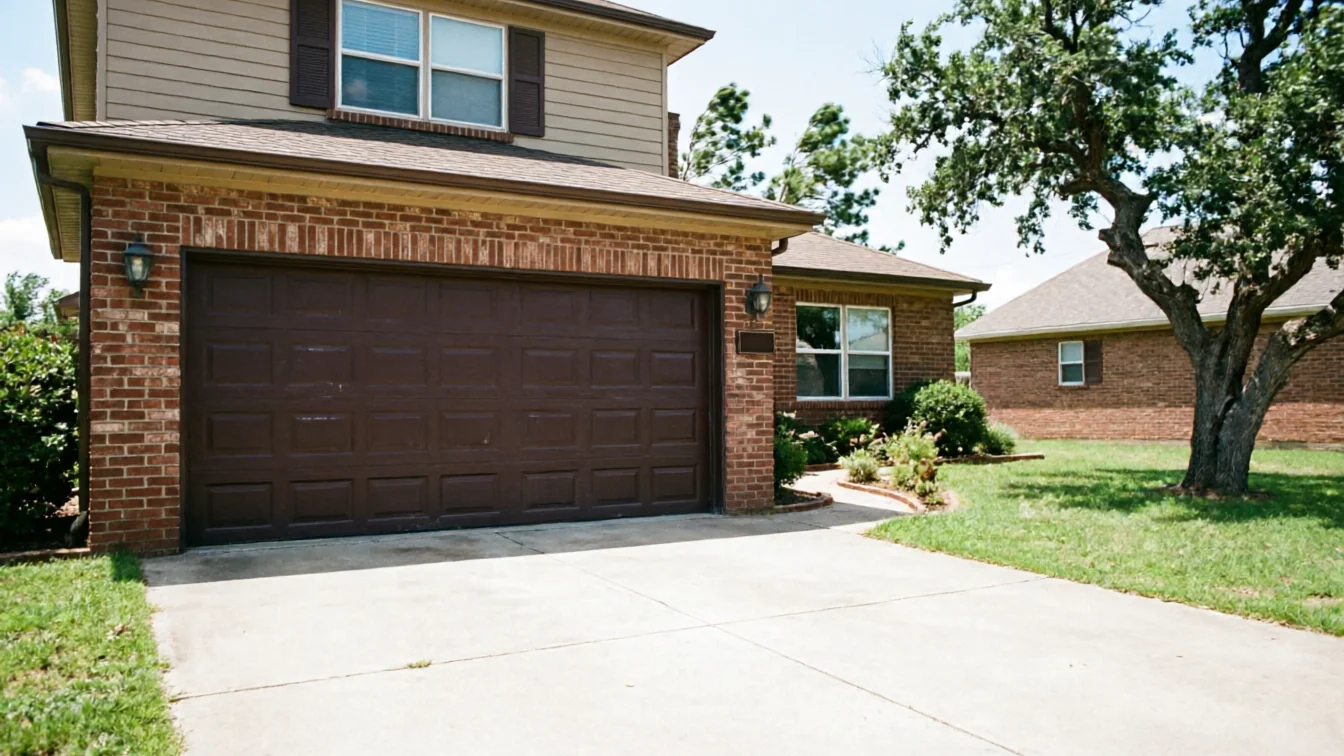
What That Noise From Your Garage Door Is Trying to Tell You
Bedford homes built mostly in the 1980s and 90s have specific noise patterns tied to original hardware and heat cycling.
Read guide
Weather Seals and Draughts in Bedford Garages
Bedford homes built mostly between 1953 and 2014 develop gaps around garage door seals from heat cycling.
Read guide
Bedford Garage Door Openers and Power Outages: What Actually Fails
Bedford, TX garage openers built in the 1980s-90s often fail during storm power cuts and summer heat spikes.
Read guideReady when you are
Need a garage door sorted in Bedford?
Bedford Garage Door Pros repairs and installs garage doors, springs and openers in Bedford, TX and the surrounding area.